Saturday, September 29, 2012

Hot Potato Steaming Pocket Tutorial


At our Relief Society Super Saturday meeting we made these Microwave Steaming Pouches for Potatoes.

I was suppose to teach the class, but unfortunately, just before things got going, I decided to take a not so graceful fall onto my knee on the cement.  So, limping home I have been laid up for a couple weeks trying to recuperate.  I will not share pictures of the injury...don't worry.  I know most of you would like to keep your food down.   Brenda Allen was kind enough to teach the class for me.   Anyway, if you weren't able to make it to the class, here are the instructions and a mini tutorial.  They are really easy, don't over think the process.  


You will need the following:  

One piece of COTTON batting measuring 10" x 22"
Two pieces of COTTON fabric measuring 10" x 22"
Your sewing machine, some thread.


Layer as follows, batting on the bottom, one piece of cotton fabric face up on top of the batting and the remaining piece of cotton fabric face down on top of the first fabric, as shown above and below:


We are going to sew through all three layers on the short ends ONLY.  It is not necessary to pin, but if you want to do so, I would suggest that you pin as shown below so that your pins are back from the area where you will be stitching, that way you don't have to stop and remove them as you sew or worry about them getting caught under your needle.  Sew 1/2 inch from the short edge on both ends of the fabric sandwich.  Remove your pins.


Put  your hand between your fabric pieces and open it up, as shown below, you should have a loop now.  Turn this loop so that the fabric is on the outside and the batting is on the inside, Press your ends flat and top stitch the ends ONLY.

Notice again, in the picture below, as I am top stitching the ends, my pins are set back so that I have no need to stop and remove them until I am finished.


 Fold one side in and then the other, overlapping the top stitched edges by 1/2 inch.  Make sure that your Longer folded piece overlaps your Shorter folded piece as illustrated below.


Stitch 1/2 inch seam along both sides of your pouch.  I double stitched the area where the pieces overlap as that will be taking the brunt of any stress in opening and closing.    Turn your pouch and you are ready to steam some potatoes to perfection in your microwave!


Share your pictures!  I can see some of you getting very creative with this little project.  Quilting optional, patchwork optional.  Remember since this is going in the microwave, do not use fabrics that contain metallic threads, of metallic designs stamped or embossed on them.  


You may be giving this as a gift, if so, here are the directions for how to use your Hot Potato Steaming Pocket.


To use your bag: wash and dry potatoes, DO NOT PIERCE. Place potatoes in bag and place bag in microwave. Microwave per microwave manufacturer instructions. DO NOT OVERCOOK. This bag will hold from one to four potatoes. This is a great way to cook sweet potatoes.



Tuesday, September 11, 2012

Craftsy BOM Blocks for September and February Remake


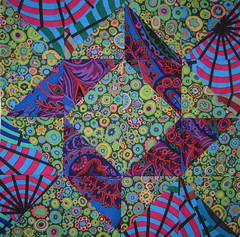
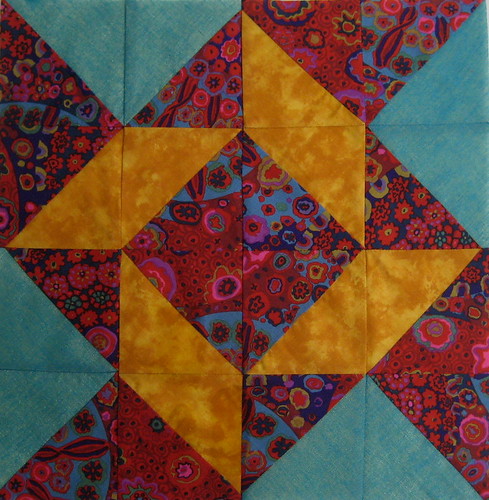
February's Block was the Balkan Puzzle.  I wasn't happy with the one I made originally, you can see a picture of it below.  I went in a different color direction and it needed a remake.  I like this one now, it looks like a fire opal from across the room.   I still don't care for the technique because it leaves you with cross grain edges which can be difficult and easily stretched.  Just my personal preference.

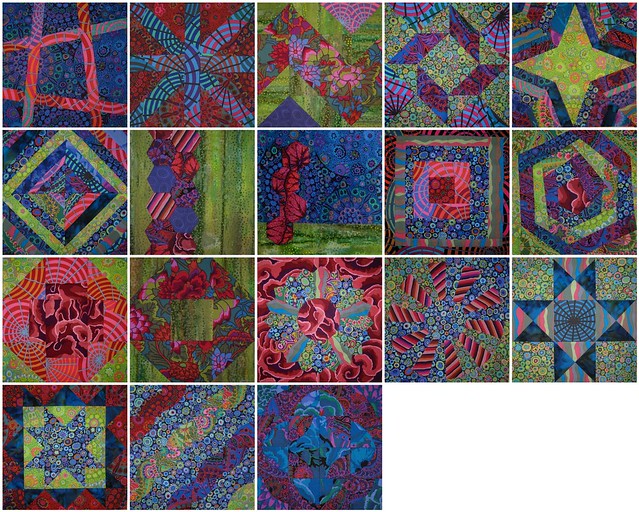
You can see how it looks in the grand scheme of things now...


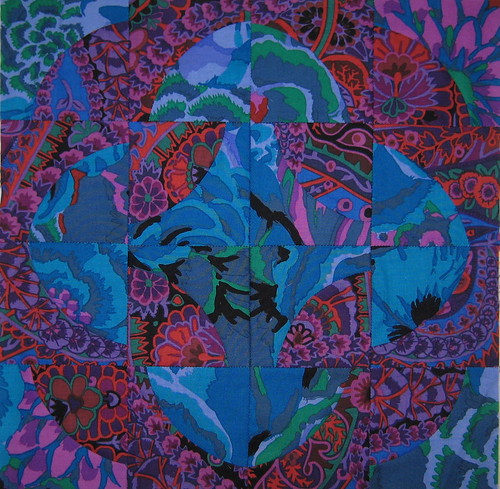
The other two blocks that were made for September are both made using curved piecing.  I love curved piecing and although they are technically perfect...you cannot see the detail of the block because of the choice of fabrics...note to self...more contrast in color and size of elements.  But they are pretty and will blend in so I am not going to redo them.


If you like these blocks and want to make your own...check out Craftsy.com  The course is their Block of the Month and it's FREE!  Lots of fun each month, videos are always there for you to refer to, printed handouts for reference and you can view the contributions of those that are also taking the class.  They have lots of free classes for you to sample and some fabulous pay classes that are very reasonably priced.  The subjects run from cooking to sewing, to quilting, to knitting, you name it!  That's Craftsy.com  check it out!


Monday, September 3, 2012

Quilting Tips


I have finished quilting my Newby Quilting Bee quilt and thought I might share some tips with you as you are starting to quilt your top.  
You will want to quilt your long sashing strips first, this anchors your quilt into nice little sections and makes it easier to get a cleanly finished quilt top.  I elected to do all of my stitching on this quilt in the "ditch" with the exception of the Dresden Fan Block, that block I echo quilted.  I also elected to utilize a clear thread for my top and a muted gray brown for my bobbin thread.  You can do what ever you wish.  There is no right or wrong way.

NOTE:  Before you start:  Make sure your machine is clean, well adjusted, you have the correct thread and sharp quilting needles.  Use a quilt sandwich made from the same materials you are using in your quilt to practice and adjust your stitches before you start quilting your actual quilt.  Good time to adjust your pressure foot also if you need to.
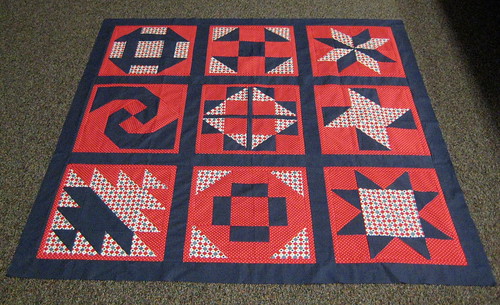
When you are stitching in the ditch, it's nice to have a clear thread so that your stitches do not show.  This method of quilting a quilt, let's your blocks do the talking.  Also, if you are making a quilting to toss over you, you will find that it gives you a softer finish for a more snuggly quilt.  The more you stitch your quilt, the less flexible it will become.  Lots of detail quilting is pretty for an art quilt that you will not actually lay under (a beautiful bedspread that you fold up at night rather than sleep under) or a wall hanging, or a table runner.  Check your quilt batting to see how close you need to stitch to secure the batting and keep it from shifting as you use your quilt.  This is important.  It's not fun to go to all the work to make a beautiful quilt top and then to wash it a few times and notice that all the batting has shifted and you have a lumpy quilt.  All that can be avoided.


Okay, so here is a picture of stitching in the ditch...you will notice that my needle is right in the seam or "ditch".  I use my longest straight stitch and practice on a quilt sandwich before starting out, making any necessary adjustments to tension that may be necessary.  It's good to get all those things sorted out on your practice piece rather than on your actual quilt.  


NOTE:  Take one stitch and bring your bobbin thread to the top as shown above!  Always do this.  You don't want a mess on the back of your quilt to try to sort out later.  This easy step will help you to have a secure and beautifully finished top.  


You will find, as you are working on your quilt, that it will help you to roll up the portion of the quilt that is passing through the neck of your machine as shown above.  It's very important as you quilt that you not have anything dragging on your quilt top.  Sometimes I toss the quilt over my shoulder to support it.  Make sure that it moves easily and that you have sufficient table space surrounding your quilt that it is NOT hanging off the table.  You want fluid motion, not drag.  If you are working on a very large quilt, or have thick batting, you may want to get a couple bicycle clips to hold your rolled quilt in place, back away from your work area.

Once you have quilted all of your sashing, starting with the long strips and then the short strips and the outside, you can then quilt each of your blocks without worrying that things will shift horribly. If you are quilting a large quilt without sashing, just do the same thing, divide it up into sections and get those sections secured, then quilt off those sections.

What do you do with all those threads on the top of the quilt now.  Well, don't just cut them off...as you wash your quilt, your quilting will come undone.  We don't want that.  Take a moment and tie each of the threads into a knot, thread them through a sharp hand needle with a large eye and insert the needle right where your knot is, weave your needle through the batting and out about an inch or two and pull it back up on top, give a gentle tug and your knot will slip into the inside of your quilt and be buried in the batting.  Carefully clip your thread at this point.  See the pictures below. 
Tie a knot close to your top, do not clip threads!
Thread a sharp hand needle with the remain threads.
Take the needed and insert it right where the threads came up and weave it into your batting, do not go all the way through to your backing.  You want to weave out for about an inch or so and then pull the needle and threads up to the top of your quilt again.
Now give a little tug and your knot will bury it self into your batting.

CAREFULLY clip your thread, it will draw back into the batting and should be invisible now.


The next thing we need to do, it prepare our quilt top for binding.  You do this by squaring up your corners using a square ruler and trimming off the side bits that extend out from your top.  (remember, we gave ourselves plenty to work with.)  Use your ruler to measure your side carefully as your are cutting with your rotary cutter and mat. 
Use a square up ruler to square all four corners before you trim off the sides.

Okay, you have this beautiful trimmed quilt, ready for binding and a nice little stack of scrappy stuff left over.  DON'T TOSS THAT OUT!  I will show you what to do with that in a bit.  Don't waste!  Fabric is expensive and you already have the makings of something fun here.  

Before I close...this is by NO means a tutorial on quilting.  Just some quick pointers that work for me.  There are tons and tons and tons of books and websites that offer advanced tutorials and instruction on quilting.  It's an art, it takes practice.  Don't be impatient with yourself, practice does make perfect.  And remember, we have seam rippers, nothing is beyond repair.  Quilting can be and enormous frustration or it can be an exercise in meditation...it's your choice!  Put some beautiful music on that you enjoy and get into the groove!


One last picture...this is the backside of my quilt!  I didn't want to go into town to get backing fabric, nor did I want to spend the money.  The strips are left over from cutting the top and a couple extra blocks, cobble them together and you have the back.  Your back may be one solid fabric, or you make choose to do something fun on the back.  It's always your choice!  

We will be meeting this week on Thursday and Friday September 6th and 7th from 9am to noon to help you get your tops quilted and ready for the final step of binding!  Then the following week, on Friday September 14th from 9am to noon, we will tackle binding and inserting sleeves if you wish to display your quilt.  You are almost finished!!!


The Seventh Annual Colfax Outdoor Quilt Show will be held on Saturday October 6, 2012 from 10am -4pm in the little town of Colfax, CA.  Entries must be submitted by September 21st to be considered for the show.  Your quilt must have a 4" rod pocket and there is a $5.00 entry fee.  I hope you gals will consider entering your quilts in the show.  It's lots of fun to see your quilt on display and to hear the lovely comments from folks as they walk by.  If you are interested,  I will have entry forms at the meeting Thursday and Friday or you can contact me and I will get one to you!

Here is a link for the Whistle Stop Quilt and Sew Shop:  http://www.zoomaru.net/index.php?id=0&display=portal&eportal=whistlestop

They have a great calender of events coming up and some really lovely fabrics in their shop.  If you have been wondering about machine maintenance, they have a special class you can take. Suzanne Maguire and her husband Larry have just celebrated their 5th year in business at that location.  Please support them when you are in Colfax.  

Remember these?  Well read below to see what you might do with your trimmings!


Here is what I did with the left over scraps from trimming the batting and backing from my quilt.  I cut all the pieces 12.5 inches long.  Took a piece of fabric from my stash for the back and laid the strips and the batting down until I covered what I wanted.  Then I flipped only the fabric strip over and stitched them right sides together all the way through to the backing. Your bits of batting will be secured with the stitching, you can just butt them right up to each other and pin them in place until you get them stitched.   When it's all covered the size that you want, trim it up and bind it.  You can make a fun table runner or book cover this way...or even a piece of fabric that you could use to make into a tote!  The possibilities are endless.  Just have fun!  


Trimmed into 12.5 inch strips

lay them out in a pleasing manner.

Stitch them to a piece of backing fabric, bind them and you will have some fun snack mats.


Saturday, September 1, 2012

Sophie - The Wonder Cat - Quilts With Me.


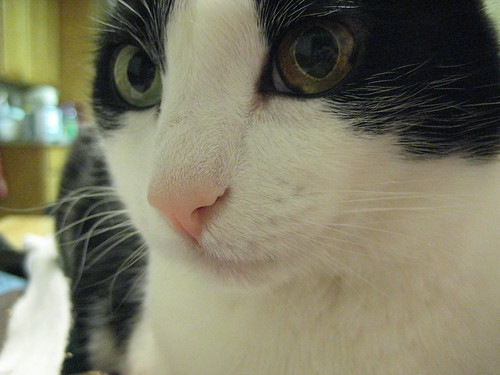
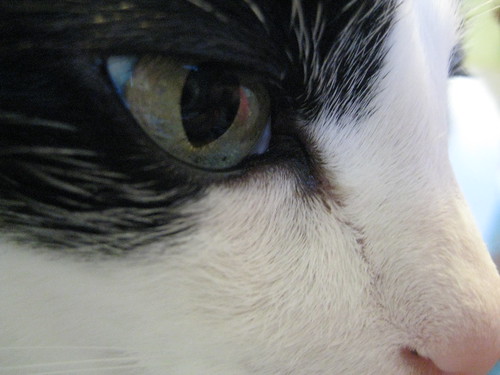
I thought yesterday would be a good day to get started quilting the Newby Quilting Bee quilt.  You can see by the look on Sophie's face that she recognizes that she has work to do and she is quite ready to help!  

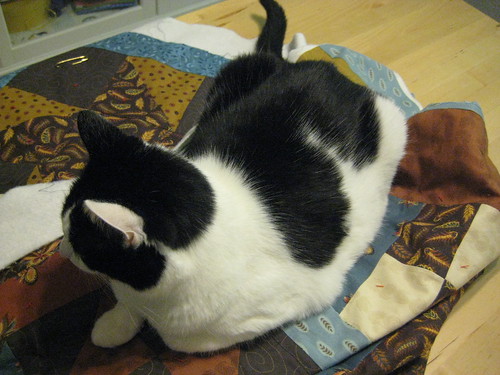
Yes, she is in position, holding the work in place, making sure it doesn't fly off the table as I quilt.  
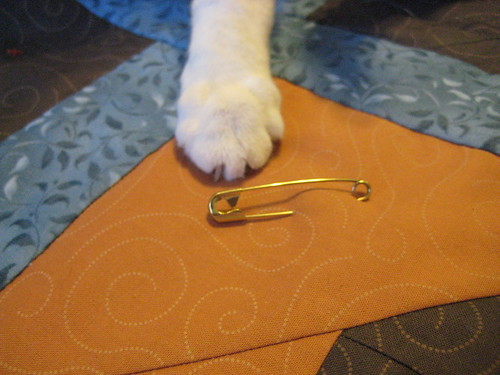
She has carefully pointed out an area that needs quilting.  Very gently so she won't hurt my feelings.
She is a scrutinizer and a tough one sometimes.  If she doesn't like what you are doing she can be immovable from her position.
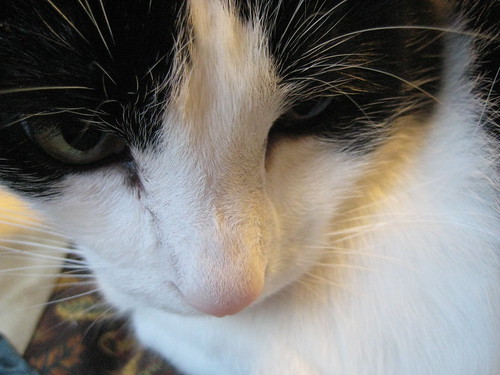
Always an eye toward detail!  Nothing escapes her purrview. 
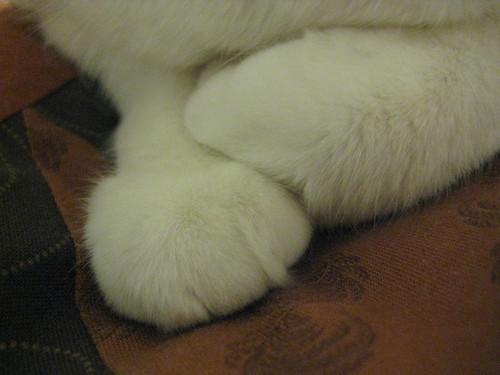
Those feet look so dainty curled under, don't let her fool you!  She has some mean meat hooks that she loves to use on her daddy. (he plays rough, so he deserves a hook now and then)
She is telling me that I need to get back to work now, so I better step to it!  We are three quarters of the way through it now and it's looking lovely!  Thanks Sophie for your unwavering help, I could never do this without you!


Friday, August 10, 2012

Newby Quilting Bee - Pinning the Quilt Sandwich

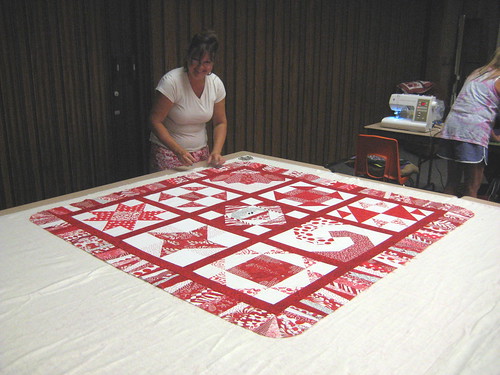
Teri Williams Quilt

We got together this morning for our monthly meeting of the Newby Quilting Bee.  Today we learned how to make the quilt sandwich and pin our quilts.

So to begin, you need to measure your quilt top.  Then you need to have enough batting and backing to go 3-4 inches beyond your top. If you are going to be having your quilt, quilted by a longarm quilter, they will instruct you how much additional fabric and batting you need beyond your quilt top for their purposes.  So, check with them first!  If you are quilting for yourself, on your table top machine, then this will be sufficient for our purposes.

Make sure you have pressed your top and your backing so that they are wrinkle free.  We pushed two or three tables together to avoid having to get down on the floor and pin our quilts.  You may want to do this at home as well.  Folding tables work fine, you don't have to worry about the pins scratching your good dining table.  If all else fails, you can use the floor, you have more stamina than me...LOL.
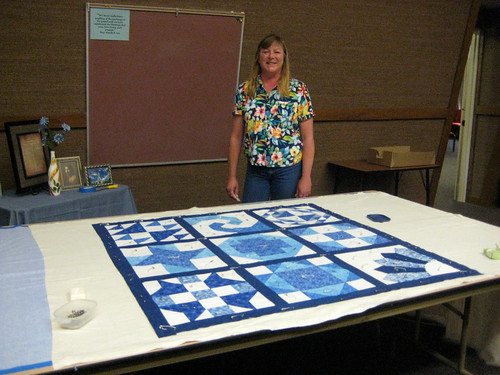
Brenda Allen's Quilt

First, lay your backing fabric down with the wrong side facing up.  Take your masking tape and tape the edges of your backing to the table so that it is snug and wrinkle free.  Don't stretch it, just smooth and wrinkle free.

Next, lay your batting on top of your backing fabric and start to smooth it from the center out to the edges.  Depending on the type of batting you are using, you may or may not have to tape it as well.  Some of the high loft battings will do better if you tape them.  If you are using a "Warm and Natural" brand you can just smooth it and it will be fine without taping.  Now don't freak out if you bought a huge piece of batting and it is way beyond your quilt, you will trim it in a bit, but not yet.

Now, lay your quilt top on the smoothed batting.  Again, starting from the middle of your quilt top, smooth your top from the center to the edges.  When you have completed this process you are ready to pin your quilt.

SIDE NOTE #1:  See Brenda's cute border on her quilt above?  Well, she was worried about the strips coming apart as she worked on the quilt top.  The easy solution is to topstitch 1/4 inch from the edge all the way around and that will stabilize those edges.

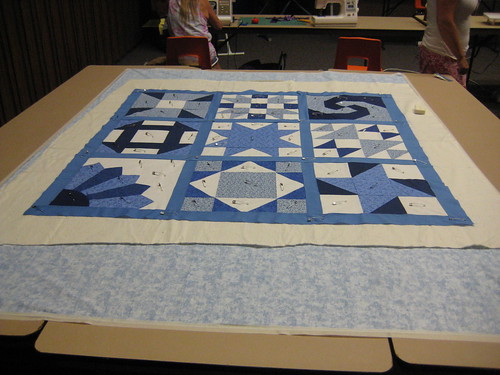
When you purchased your batting, it would say on the package or the bolt end, how close you need to quilt.  When you are pinning, think about what kind of quilting you may be doing.  Stitch in the ditch?  Stitch next to the ditch?  Echo quilting?  Lay your pins out so that you are not having to stop every five seconds and remove and replace pins as you quilt.  Using your safety pins, pin through all layers.  I like to pin about every 6 inches or so.  You want it to be secure so that as you are wrestling it around and quilting, you will not have things slipping.  


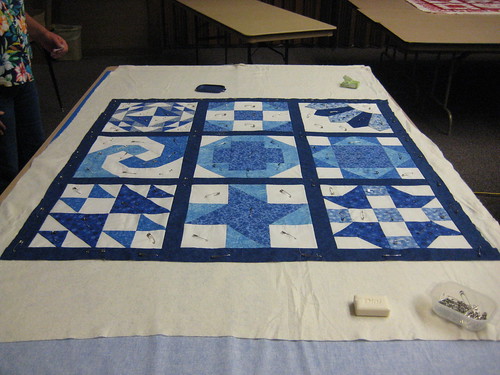
Teri's Pinned Quilt
Sometimes, if you are having difficulty getting your pins through easily, remember the trick your mother taught you when you were diapering your babies.  Have a little bar of soap handy and run you pin across it and see how easily it glides through your quilt sandwich.


Janeal, Brenda and Shirley engrossed in their decisions.

Once you have finished pinning your quilt completely, you can trim around the quilt top, 3-4 inches out from the top.  You should have a margin of batting and backing sticking out beyond your quilt top by 3-4 inches.


Ramona Smith's Quilt
Now that you are finished pinning and have trimmed your batting and backing, you can roll your quilt up from one end to the other.  Do not fold it, we don't want wrinkles and folds to have to quilt around, rolling it will keep it in a good state for when we start to quilt our tops!


Shirley Statham's Quilt

Shirley Statham had a good friend who is a quilter and helped her  to deal with odd sized blocks, she simply bordered around each one with a thin strip and then cut them all to the same size and continued on, it's beautiful!  Shirley has been going to town on her quilts and has finished 3 already!

We will meet again on August 24th to start quilting!  Bring your quilt sandwich, your sewing machines, fresh needles, your quilting thread and plenty of bobbins wound with your backing thread color, scissors and a container to place your pins in as you remove them.  You will not need your cutting mats or rotary cutters for this meeting.

Let's talk about thread.  If you are stitching in the ditch and do not want your thread to show, I would suggest you get a clear poly quilting thread.  Here is a link for Superior Brand.  You can find this at most fabric stores and it's available online as well. http://www.superiorthreads.com/product/Brand/monopoly/
Here is another link which offers several brands.  http://www.redrockthreads.com/misc-thread/invisible-thread.asp
And a link for Aurifil.  http://www.aurifil.com/Aurifil/Invisible_thread.html
Get a poly rather than a nylon thread.

You will only use this thread in your top, you will use regular thread in your bobbin.  I can't stress enough that you load several bobbins, nothing is more annoying that having to take everything apart to wind a bobbin, just when you are getting in the groove.  

It was a blast today, seeing everyone's quilts and I am so excited for our next meeting.  Oh!  One more thing.  Please bring a little sandwich to practice on before we turn you loose on your quilt.  A piece of fabric about 12 x 12 inches with batting and backing as well, will be fine, use an extra block or bits of fabric that you have sewn together so we can practice the stitch in the ditch and others.  


Saturday, August 4, 2012

Swooning on a Saturday


We were going to go over to see our Granddaughter for her 1st birthday today, but Grandpa is not feeling well and doesn't feel up to the long drive over and back, it would be 7 hours in the car round trip.  I understand, but am disappointed not to be able to share in her day.  He has been having a difficult time lately so I have to respect that.


So, I was up early this morning, hoping to get in some sewing before we were going to leave at 7am.  The power was out yesterday afternoon and I was unable to get any sewing done, not to mention the unbearable heat.  It was over a hundred outside.  Not a good thing to have the power go out in the afternoon.  Anyway, we made the best of it, enjoyed an early dinner of skillet fried chicken and a big green salad.  Spent the time catching up on some magazines and had a generally peaceful afternoon.  Power came back on about 8:30 so we got in a little tv time and then off to bed.


I modified this Swoon block a bit by inserting bits on each of the center sides.  I like that way it looks, we will have to see how it works into the entire quilt.  Thought I would mock up a finished top and see where I am going with the last two blocks that I have yet to complete.

The brightness of each block is different in the photos but in true light, they are all the same intensity.  It will be interesting to see how it looks when it's completed.  Well, off to pour through the fabric and see what I want for the final two blocks.